The Poetic Method: An Interview with Poet Samantha Grabler
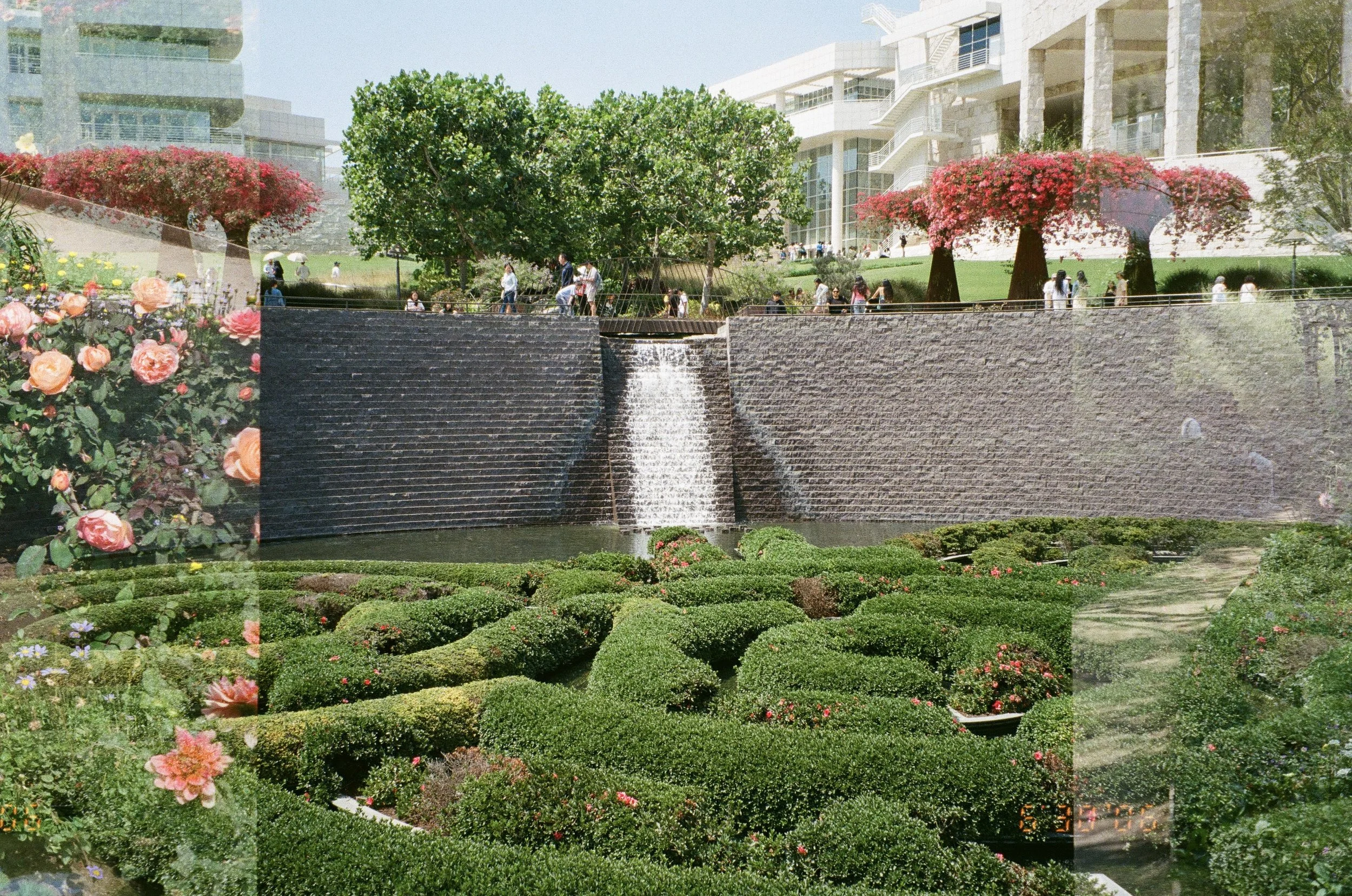
The Getty Garden by Taylor Goldstein
“The most dangerous worldview is the worldview of those who have not viewed the world”
- Alexander von Humboldt
Introduction
I first heard of Humboldt as a place my cousin went to school. I knew what my parents knew it for: coastal redwoods and cannabis farms. Back then, I hadn’t an inkling that the German philosopher whom the county was named after was the father of modern-day ecology and environmentalism.
His mid-nineteenth century book, Kosmos, with the description of “all natural forces [as] linked together,” served as a direct influence to the works and lifestyles of more well-known names like Henry David Thoreau and John Muir.
Samantha Grabler is not a well-known name. Not yet, at least. Like many of us, her literary life started in her journal. Starting shortly after college, writing became Samantha’s way of processing. “I never really wrote with the intention of other people reading my work,” she told me about her journaling. Instead, she wrote freely and introspectively: “I’m writing about this, so it must be bothering me.” “How many pages have I written about this feeling?”
Samantha still maintains these methods of internal inquiry. Looking back through the many journals she’s filled reminds her of an old headspace, but with a pride of how far she’s come.
Setup
Samantha Grabler grew up in Edison, New Jersey, a city named for the inventor who set up lab there. She always enjoyed the writing classes she took, but knew that she preferred STEM by the time she went to Penn State. She graduated from university with a major in forensic biology and a minor in biochemistry and molecular biology.
Hypothesis
Samantha’s professional life was suddenly interrupted by health issues. During recurring hospitalizations, she began journalling much more. This wasn’t poetry, not yet. Just that same almost-scientific process Samantha had used all her adult life to distill her thoughts.
Then came inspiration in the form of a compatriot of the hospital, another woman who wrote despite the struggling of her body. She read Samantha a poem of hers. “Maybe I could write something like that,” she thought from her hospital bed.
Research
Samantha began to write poetry, still for her eyes only. She surrounded herself in deep thoughts: the physics and philosophy of James Glatfelder, the spirituality and awareness of Gary Snyder, and even the rhythm and poetry of bands like Slightly Stoopid. Samantha got better, poetically and in health. She had been working outside of Philadelphia for a non-profit specializing in auto-immune disease research, but moved back to New Jersey to heal. After recovering, she unpaused her lab work, now focusing on cancer research. The more Samantha learns, the more she realizes that there is “so much we can’t perceive.”
Cancer is about as complex as it gets (at least to me). It emerges within the body, but with an entirely separate goal from the rest of the body. Any cure to the disease would not only require a great scientific understanding (which is above me) but also a poetic understanding. This is the interdisciplinary approach that Humboldt, Glatfelder, and now Grabler have used to understand the world we live in, or, as she put it, the “ultimate reality.”
Experiment
These are some of the thoughts that color much of Grabler’s poetry. The first poem she ever thought about publishing was her submission to a quantum physics poetry contest. “Yes, a quantum physics poetry contest,” she confirmed to me.
But there was another catalyst influencing her poetry. Around this time, Samantha’s partner sadly passed away. Her poem titled The World Should Stop For You was published about a year ago by a literary journal calledHarrow House. Though that poem is more explicit in her grieving process, notes of this experience are present throughout her poetry.
Results
The Third Dimension, which has been published in the latest volume of the Santa Barbara Literary Journal titled Mysterious Ways, is a deeply personal poem about Samantha “questioning [her] place in the universe.” In it, she calls herself “caged by coordinates,” suggesting that someone on the other side of life may not carry those same restrictions. She complains of “time’s forward flow,” harkening back to her previous poem about a world that doesn’t stop for the dead and the near death. Her line, “in this void, Nothing’s destroyed,” which is in reference to matter from the scientific perspective, has a completely different meaning in the eyes of someone experiencing grief.
Conclusions
And yet, the poem is anything but simply about mourning. As it is self-described from line one, it is “triaxial” - on three axes (I had to look it up). It is a poem of grieving, but also a poem of movement. “It’s sometimes too fast… too slow;” “There’s a down direction;” “Change is the constant.” In the theme of movement, Grabler employs three different methods of pacing: commas, ellipses, and dashes. Each different punctuation mark gives the reader a different rate of acceleration through the poem. To me, this poem is about moving through mourning while locating the third axis, self-awareness. The last two stanzas, with lines like “my perception,” “our detection,” and I’m “Stuck here in this Third Dimension” give strong finality to the poem, like someone finding the actual X,Y, and Z coordinates that they lie on in the graph of the universe. Grabler defined these coordinates as “my ego, what I really am, and the world around me.”
You can find Samantha Grabler’s poem The Third Dimension in the Poetry section of our website. For more of Samantha’s wonderful work, her poems Mania and Ripple Effect can be found in Volumes 12 and 13, respectively.
https://samanthagrablerpoetry.com/
“I like having my hands in everything” - Samantha Grabler
