Magical Words: An Interview with Artist-Poet Janina Karpinska
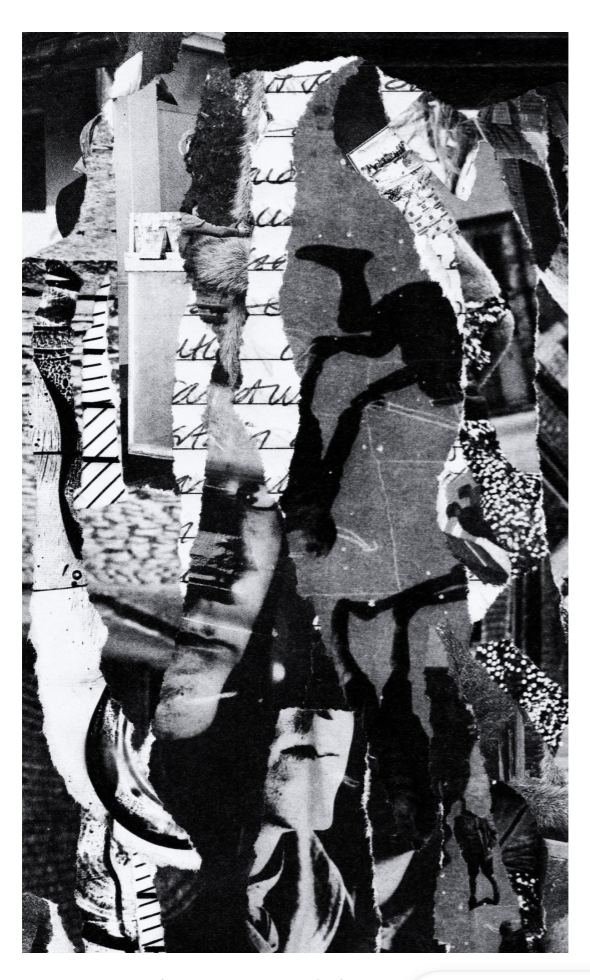
Mind Turning Somersaults - Janina Karpinska
Janina Karpinska combines literature and visual art. “The words came first,” she told me in reference to her career, though it holds true for her process in creating Mind Turning Somersaults. Inspired by Julia Cameron’s The Artist’s Way, Karpinska’s first action every day has been handwriting three ‘morning pages.’ “Well, after I’ve made my coffee,” she reassured me. “It's about turning up at the page every morning no matter what kind of day it is or how you feel - it all comes out.” It is one of these ‘morning pages’ that provides the backing paper for Mind Turning Somersaults, as well as Thoughts Vying for Dominance, another Karpinska piece located on our website. Once finding an old ‘morning page’ that she’d be “glad to cover over, [she]’d set to it with glue-stick, magazines, and scissors.” This unique mixture of writing and collage is extremely vulnerable in form. It is a self-portrait of one’s mental process. Mind Turning Somersaults displays Karpinska’s handwriting; it displays her thoughts in narrow strips; it even displays the silhouettes that act as canvas in her mind’s eye. There is so much vibrance and creativity packed in this small, black-and-white collage.
Thoughts Vying for Dominance is similar. Rigid geometric shapes fitted into circles are pasted atop an already scribbled out ‘morning page.’ The black-and-white color scheme is present in both pieces, but don’t let it fool you. Both artworks are honest and vulnerable and yet only display a sliver of Karpinska. Her work is inspired by “dreams, fears, hopes - the lot,” evidenced by many other published palimpsests bursting with color. This tendency to display her mental process on the page is as “much an artform as a form of life-support.”
Karpinska was excited to share Tom Philips’ erasure technique with me as well, the practice of manipulating the words on a page only to leave the ones you want. “It’s perfect for people who can’t believe they have it in them to be ‘creative,’” she told me. “For people who think they can’t write - they don’t need to - the words are all laid out for them.” Then, as proof, she told me a story of using this method as a homework assignment for an art therapy training course. Unfortunately, the copies she had grabbed for everyone to manipulate were of a rather “dry document” of “wordy legalese about college accreditation.” Nonetheless, someone had left the words: “sing, and be still, sing,” found in the ends of words such as “revising [or] increasing.”
As only a receiver of the story myself, I was convinced to try the technique. There is a Matisse art book that lives near my bed. Many of the paintings in it are cut out, and a couple of them color my wall. But this left a lopsided book with many half-pages of historical background. Going to work on some of these, it was interesting to see what I chose to remove and what I chose to leave behind. Karpinska had already mentioned that “the words choose you,” and that seemed to be a more accurate description of what was occurring. By the end of it, I was left with a page full of blue and red circles and swirls, and four inconspicuous words, though ominous when placed together: the place was Baltimore. I don’t know what that means for me, but I do know that the process was exhilarating and that I’ve continued creating erasures. As I strike through more and more lines of text, I learn more and more about my own mental processes.
“Somehow the words appear as if by magic.” - Janina Karpinska - Artist / Poet / Teacher
